Monday, 1 November 2021

November 1307 - Marriage of Piers Gaveston and Margaret de Clare

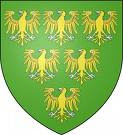
 As soon as Edward II recalled Piers Gaveston from exile he set about making Piers part of his family - the Royal family.  The best way to do this of course was marriage.  The bride chosen was Margaret de Clare, the king's niece from his sister Joan of Acre and her husband Gilbert de Clare, Earl of Gloucester.  Piers had been made Earl of Cornwall in August, before his marriage to Margaret de Clare.  What is interesting to note is that Piers' Coat of Arms as Earl of Cornwall already had the arms of the Clare family as part of it's design - before the marriage had taken place.  It seems clear the marriage had been planned for some time.

The marriage itself took place at Berkhamstead on November 1st.  The King himself attended, along with some of the nobility.  Naturally, Edward's generous character was on show.  There's very little mention of the wedding ceremony in the chronicles, but we do know Edward gave £30 of jewels to the couple, gave Margaret a palfrey worth £20, another £20 on minstrels, gifts for her ladies worth £36 and he even arranged for coins worth over £7 to be thrown over the couple at the church entrance.  It must have been a day of great celebration for Edward and Piers, and hopefully Margaret.  Whether her brother approved, we just don't know, but then his sister would now be Countess of Cornwall, and married to the King's favourite.


Saturday, 16 October 2021

Piers Gaveston's First Exile

 Piers Gaveston had been appointed to Prince Edward's household in 1300 by his father, Edward Ist.  It seems Piers was chosen because of his chivalrous attitude and good manners, a suitable role model for the young prince.  Yet in 1307, he was banished by Edward Ist, for an incident described by Walter of Guisborough, the only chronicler who mentioned it.  According to Guisborough, the Prince had asked his father for the county of Ponthieu for Piers.  Or rather he asked his father's treasurer, Walter Langton, Bishop of Coventry and Lichfield, to ask him.  Edward Ist summoned his son, grabbed him by the hair, tearing it out, and yelled 'You wretched bastard, do you want to give lands away now?  You who never gained any?'  He then called his council together and banished Piers from the Kingdom.  Having read this account, you would assume that Piers was promptly marched to Dover and sent on his way.  But this is not what happened.  Edward 1st appears to have calmed down enough to order Piers leave the country three weeks after the next tournament, to return to Gascony, and stay there until he was recalled.  Not the actions of someone who was in such a foul temper, abused his son and ripped out his hair because he thought his son's favourite companion had the audacity to ask for the county of Ponthieu.  The official court records give a different account.  The Prince and Piers were to swear on Holy relics they would respect the terms of the exile.  The exile wasn't even permanent - Piers would be recalled.   Piers was even given time to arrange his exile, and did not even go to Gascony - he actually went to the much disputed Ponthieu.  Neither Piers or the Prince were denied the opportunity to meet up before the exile. Prince Edward accompanied Piers on his journey to Dover.  They even traveled at a leisurely pace.  They traveled with members of the Prince's household and even took along 2 minstrels with them.  The Prince also gave Piers many costly gifts.  He was given a number of expensive tapestries, two costly tunics and 5 horses and a cash gift of £260.  Monies were also given to the members of the household accompanying Piers. Edward 1st promised him 100 marks a year for each year he was in exile.

Even after he had left England, the Prince sent on more costly gifts.  Piers obviously intended to make his exile as comfortable as possible.  It seems he would spend his time entering a number of tournaments and the Prince sent him 2  expensively made tournament outfits - one of green velvet embroidered with pearls and gold and silver piping, and also another outfit in green.  Green obviously suited Piers!  Both were decorated with the arms of Gaveston.  He would make quite a spectacle in tournaments.  Far from leaving England in disgrace, Piers also took with him 2 knights, a chamberlain, 2 falconers , some servants and several grooms from the Prince's household.  Maybe even the 2 minstrels went as well!

It was a very generous exile.  Piers was well supported by his household, had been given lavish gifts by the Prince, with the intention he would busy himself entering tournaments.  At some point, he hoped to be recalled by the king.  Prince Edward had felt the full force of his father's fury - even if the story of having his hair pulled out wasn't true.  So, was the reason for the exile an argument over Ponthieu?  Or was it something else?  Was the King angered by the Prince entering in to some sort of brotherhood pact with Piers?  Or had he realised his son was besotted with Piers?  Did he suspect they were lovers?  And if so, was this the reason for his anger?  Or was it the influence he thought Piers would exert over the Prince?  From the King's actions, it would appear his anger was with the Prince, and not Piers - hence the fine send off he was given - and knowing the exile was not forever.  Perhaps the King hoped Piers would enjoy his life in exile and be content to stay there.  Or that whatever 'hold' he had over the Prince, it would evaporate - out of sight, out of mind, so to speak.  But it was not to be.  Within 3 months, the King was.  His son became Edward II and he immediately set out to bring Piers Gaveston back to England.


Sources - 'Edward II' by Seymour Phillips

'Piers Gaveston, Politics and Patronage in the Reign of Edward II' by J S Hamilton 


Saturday, 4 September 2021

A Visit to Hever Castle

 Hever Castle is the ancestral home of Anne Boleyn.  I've been fortunate enough to visit it a few times.  Obviously the castle has changed over the years but you definitely get a feel of what life was like for the Boleyns.


The castle is set amongst some fabulous gardens and is surrounded by a moat.
This is the church near the castle.  Anne Boleyn's father, Sir Thomas Boleyn, is buried here.
Hever Castle has some wax figures at the castle.  This model is of Anne Boleyn, clutching in her hand the locket snatched from Jane Seymour after Anne reportedly found her with her husband, Henry VIII.  There is also a model of Henry and Jane in the background.
The elaborate fire place at Hever Castle.


A coif stitched by Anne Boleyn.

Another scene with models, this time Anne reads a love letter sent by Henry VIII.


A tapestry on show at Hever.
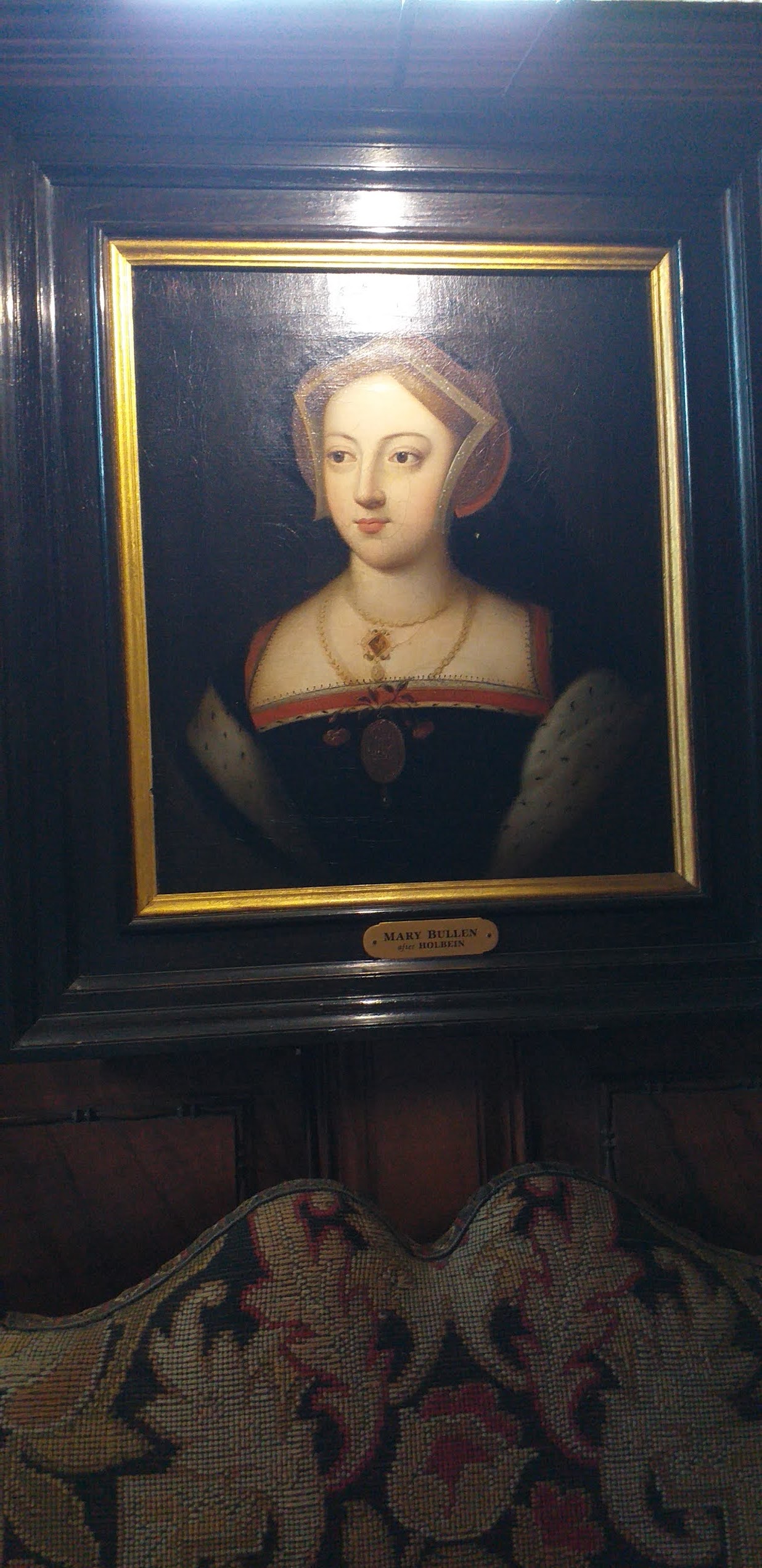
Portraits of Anne Boleyn, above, and Mary Boleyn below.

For me, the highlights of Hever Castle - 2 prayers books owned by Anne Boleyn.  Priceless!


Wednesday, 18 August 2021

A Visit to Hampton Court - The Field of Cloth of Gold

 It's been a long time, but at last I was able to to visit Hampton Court again.  I have visited the palace many times, and one of the things that keeps me going back, as with the Tower of London, are the changing exhibitions.  In 2020, the exhibition was to celebrate the 500th anniversary of the Field of Cloth of Gold, the event commemorating  the meeting between Henry VIII and Francis 1st organised by Cardinal Wolsey.  Obviously, it was unable to take place last year and has opened this year.  Tickets for the palace now have to be bought online and the palace has taken every measure to safeguard the public.  The exhibition is well worth seeing and some of the exhibits are amazing.  There's a link on the palace website to the exhibition page - Field of Cloth of Gold with a short video of some of the exhibits.   The official painting of the event was commissioned by Henry VIII later in his reign, as you can see by his portrayal.  There is so much detail in the painting and it tells the story of the preparation, the people who attended and the events that took place.   Every time I look at it, I'm fascinated and find something new.

The painting is always on show at Hampton Court (unless it is lent to other exhibitions).  The wine fountain is replicated at Hampton Court.  For me, the highlight was to actually see 'Henry VIII's hat'.   I've seen it many times on television, but never actually on show.  Just standing there thinking 'this has been on Henry VIII's head' gave me goosebumps!  Other highlights for me were the tools on loan from the Mary Rose exhibition, and the elaborate robes worn by Cardinal Wolsey.


The exhibition runs until September.   If you can't make it, check out the video on the Hampton Court website.


Friday, 23 July 2021

Piers Gaveston's 'treasure'

 After the death of Piers Gaveston on June 19th 1312, a list of his possessions and treasure was made by Thomas of Lancaster.  It is a very detailed list, and can be found in J S Hamilton's 'Piers Gaveston, Earl of Cornwall' book.  It makes fascinating reading, and not just because Piers was accused by one chronicle of stealing from the Royal treasury and hiding it abroad.  The fact that Edward II had basically put him in charge of the treasury is over-looked.  And if Piers was smuggling items abroad from the treasury, he didn't do the job very well, as the list of royal treasure is vast!   Of course, Lancaster's aim was to try to prove Piers had the treasure illegally, so there are lots of mentions of gold and silver cups and basins belonging to the Queen and other members of the royal family, including a cup that had belonged to Edward II's mother, Eleanor of Castile.  Kathryn Warner's excellent Edward II blog has a superb post about some of the items that were returned to the king by Lancaster.  Here's a link to the post -  Piers Gaveston and the Royal treasure.

Clearly some of these silver and gold cups etc did belong to Piers - they had his coat of arms on them.  There were also embroidered pearl encrusted tunics and rich fabrics, including green silk.  The list of gold and silver buckles and clasps is astounding!  Most of the items are given a value as well.  Lancaster was obviously making a point - that Piers had illegally acquired the jewels and treasure, many of which did not belong to him.   But of course, Edward II already knew this - after all, he had put Piers 'in charge' .  

I think by favourite items from the list are the 3 forks, which belonged to Piers and were used for eating pears!  Forks were unknown in England at the time, as people ate with a knife and their fingers.  The idea of the graceful and elegant Piers eating pears with his own forks makes me smile.


Saturday, 19 June 2021

June 19th - Anniversary of the death of Piers Gaveston

 June 19th is of course the anniversary of the death of Piers Gaveston in 1312.  Having surrendered to Aymer  de Valence, Earl of Pembroke, on very favourable terms, Piers was heading south with Pembroke when he was abducted by Guy, Earl of Warwick.  He was imprisoned and given a charade of a trial, in which he was not allowed to speak.  He was found guilty and sentenced to death.  Warwick, too cowardly to do the deed himself, handed Piers to the king’s cousin, Thomas of Lancaster.  Lancaster marched Piers from Warwick to his own land at Blacklow Hill.  He handed Piers over to some soldiers, who took Piers a little further, and ran him through with a sword and the cut off his head.  It seems even Lancaster couldn’t bring himself to watch such a shameful episode in English history.  RIP Piers.


The monument erected in memory of Piers Galveston in the 19th century at Blacklow Hill.
The inscription on the monument at Blacklow Hill.


Tuesday, 18 May 2021

May 19th - surrender of Piers Gaveston at Scarborough Castle.

 Parliament of August 1311 ordered yet again the exile of Piers Gaveston, Earl of Cornwall and beloved friend of Edward II.  Piers had already been exiled twice before - by Edward Ist and early in the reign of Edward II.  Each time, Edward II had worked tirelessly to bring Piers back.  This third exile was more serious in that the powerful nobles of Edward's reign had appointed themselves 'Lords Ordainers' who sought to reform the King's household and free him from the evil influence of those who brought ill to the kingdom - and that was of course Piers Gaveston, public enemy number 1.  No doubt it was jealousy of the closeness between Edward and Piers that was the driving force, and the fear of the influence of Piers, who was accused of giving the King bad advice and sidelining the King's 'loyal' followers.  Edward had tried everything to avoid sending Piers into exile - including shockingly to agreeing every other demand by the Ordainers if they would allow Piers to stay.  But it was not to be, and Piers was sent into exile.  If he ever did go.  He certainly lay low and hidden from the nobles.  Edward of course had probably begged him not to go, and that he would work for the exile to be revoked.  Plus Piers wife, the King's niece Margaret, was heavily pregnant, and no doubt Piers wanted to be with her.  Piers was reported back in England by January 1312, and was reunited with Edward at Knaresborough.  I'm sure Edward and Piers were certain that once again, the charade of Piers going into exile and being re-called would continue - and probably for many more times!  So when things came to a head yet again, Piers prepared for a siege at Scarborough castle.

It wasn't much of a siege!  Scarborough Castle was a formidable castle, and Piers should have been prepared for a long siege.  He could also have fled by boat from the castle.  However, the castle wasn't set for a siege, and Piers surrendered on May 19th to the Earl of Pembroke, Amyer de Valence on very favourable terms.  Pembroke swore an oath to protect Piers and treat him well in custody.  It was hoped an agreement could be made and if not, Piers would be returned to Scarborough Castle and prepare for a siege.  Piers must have been relieved to surrender to Pembroke and would have had no doubts about his oath.  Piers should have been safe.

Scarborough Castle is now a ruin, but it's keep is still impressive.

Also on this day, Queen Anne Boleyn was executed at the Tower of London.  RIP Anne - my childhood heroine.