Monday, 18 November 2019

Dover Castle


During the summer, I finally got to visit Dover Castle.   It's been on my castle wish list for years.   There's so much history that has taken place there over hundreds of years.  It's well worth a visit, whatever period of history you are interested in.


This is a picture of the Anglo Saxon church of  St Mary, which was restored in Victorian times.  Next to it is the oldest surviving lighthouse in Britain, the Roman Pharos.  It was built to guide the Romans across the channel from France.

The current focus of the main castle is that of Henry II's Queen, Eleanor of Aquitaine, who is 'in residence' with her lady in waiting.  It was very enjoyable 'chatting ' to her.

The castle is decorated as it would have been in Eleanor's days.


There are apartments for the King and Queen, as well as private chapels for worship.


Tuesday, 15 October 2019

Piers Gaveston's First Exile

My last post dealt with Piers Gaveston earning the wrath of Edward Ist, which eventually lead to his first exile.  Piers, along with some other knights, had absented himself from one of Edward Ist's endless Scottish campaigns to take part in a tournament in 1306.  His exile would soon follow.  The King had already banned Piers - and Prince Edward's cousin Gilbert de Clare  from his household.  Was the King aware that the Prince was lavishing gifts upon Piers?  Did he think Piers was becoming an over-mighty subject, one who might exploit the prince financially.  One chronicler, Walter pf Guisborough, tells of Edward 1st losing his temper with the Prince for asking for Ponthieu for Piers, and this was the cause of the banishment.  Or did the King suspect there was more to the relationship than he had ever thought?   We will never know.  Most historians who have examined the prime sources conclude that the exile was more of a punishment for the Prince than Piers.

To begin with, Piers was not ordered into exile straight away. He was given several weeks to get things ready, and interestingly, his destination was not to be Gascony, but Ponthieu, The King would hardly have banished Pier to Ponthieu if it was what he had asked the Prince for.  The Prince was allowed to accompany Piers to Dover Castle.  Piers was to take his household with him, which included 2 knights, 7 yeomen, his chamberlain, 2 falconers and 4 other servants.  The Prince even gave Piers 6 of his own grooms.  As well as this, the Prince once again lavished gifts on Piers, including 2 outfits to be worn in tournaments - and it is known Piers entered 2 tournaments whilst in exile.  Green seems to have suited Piers, as both outfits were green - one of velvet decorated with, pearls, gold, his coat of arms and silver piping.  As well as this, Piers was given expensive tapestries and money.  The Prince also gave him 5 horses, and continued to send money.  So Piers was hardly going to suffer in his exile.  What the King must have made of this is not recorded.  Maybe he thought it was an infatuation on the Prince's part that would soon burn itself out.  Gaveston's exile was not permanent, and was dependent upon the King recalling him.  However, Edward 1st did not have long to live, and within 3 months, was dead.  Naturally, one of King Edward II's first acts, was to recall Piers.

Source: 'Piers Gaveston :Politics and Patronage in the reign of Edward II' by J S Hamilton


The impressive Dover Castle, where Prince Edward accompanied Piers Gaveston on his way to his first exile.


Wednesday, 11 September 2019

1306 - Piers Gaveston earns the wrath of Edward Ist.

Piers Gaveston had been chosen by Edward 1st to be a suitable role model for his son, Edward of Carnarvon.  Piers had probably came to England in about 1297, after fighting with Edward 1st's army in Flanders.  He was a member of the king's household in 1297-98. He obviously impressed the King, as he was rewarded with a fine horse and selected as a companion for Prince Edward on account of the fact he came from Gascony, where he had learned his fine manners. The King must have hoped that Piers would be a fine example to the Prince in warfare.

At the start of 1306, Piers must have been delighted with his progress.  He had been knighted, earned the friendship/love/esteem of Prince Edward, and yet again had been rewarded with another fine horse, this time worth £60 (a present from the Prince).  He had also been granted lands and had his own household.  Whatever the relationship between Piers and the Prince, the King seemed pleased with the guidance Piers provided.

So what caused Piers fall from favour?  Not surprisingly, in 1306, Edward 1st was conducting the next stage of his Scottish campaign.  The campaign had been going well. Robert the Bruce has been defeated at Methven.  Prince Edward had also had some success, capturing castles at Lochmaben and Kildrummy.  By September, Edward Ist had decided to make camp at Lanercost, no doubt expecting to winter there.  Piers was one of 22 young knights who decided it was not worth wintering at Lanercost - not when there were lucrative tournaments to enter!  The King had actually banned all tournaments in England because of the Scottish war. But this didn't stop Piers and the other knights leaving England to take part in tournaments overseas.  Gilbert de Clare, the nephew of the King, also went - as did other members of the Prince's household, seemingly with his permission.  For Edward 1st, however, youth was no excuse for what he saw as desertion, even if the war with Scotland was discontinued.  Edward 1st was furious, and seized the lands of the knights and they were to be arrested for abandoning their king.  When his temper cooled, aided by his Queen, Margaret, Edward issued pardons to the knights - except for Piers Gaveston.  Instead the King ordered that 'For certain reasons that immediately after three weeks from the next tournament.......Sir Piers Gaveston  shall be ready to cross the sea at Dover for Gascony, and he shall remain there until he shall be recalled by the king and by his permission'.  This was Gaveston's first exile.  It does not seem to have been done whilst the king was in a foul temper - he generously allowed Piers 3 weeks before he was to go, enabling him to take part in any tournaments until then, and the exile does not seem to be permanent.  And yet, none of the other knights received such a punishment.  So why was Piers singled out?  It seems, perhaps, that the King suspected that his son had become infatuated with Piers, and that this might lead to .......a malign influence by Piers?  some sort of pact of brotherhood between Piers or Edward?  or maybe a sexual relationship between the pair?  We simply don't know,..... however much we might like to speculate.

Source: 'Piers Gaveston :Politics and Patronage in the reign of Edward II' by J S Hamilton

Tuesday, 20 August 2019

A Visit to Canterbury Cathedral

I've recently returned from spending some time in Kent.  I've been before, and it's a beautiful part of Britain.   Of course, being in Canterbury, I had to visit yet again the Cathedral.   Here are some of my photos.

Not surprisingly, the Cathedral is undergoing yet more renovations.

The shrine of St Thomas Becket, marking the place where he was struck down and murdered by knights claiming to act for the King, Henry II.

The tomb of the 'Black Prince', otherwise known as Edward of Woodstock, eldest son of Edward III.  His wife was Joan of Kent, mother of the future Richard II, and her father was Edmund of Woodstock, 1st Earl of Kent and younger brother to Edward II.

The tomb of Henry IV and his 2nd wife, Joan of Navarre.

The funerary ornaments of the Black Prince hang above his tomb.  These are copies, and you can see the originals in the Cathedral museum, although presently they are undergoing restoration. 

Another view of the shrine of St Thomas.

The candle marks the site of the original shrine of St Thomas 


The entrance to the Cathedral.  


The tomb of Edward II's Archbishop of Canterbury, Walter Reynolds.  He was made archbishop in 1314 and was one of the godfathers of the future Edward III.  He was loyal to Edward II until 1324, when he declared for Isabella and her son, and went on to crown Edward III.

Monday, 8 July 2019

Abergavenny Castle

Abergavenny is a small Welsh town on the border with England.  The ruins of a 12th Century castle are well worth a visit.  During it's time, it has seen some turbulent history, most noticeably during the Norman kings and those troublesome Welsh Princes, said with my tongue firmly in my cheek.  Two incidents stand out.  The Norman lord of Abergavenny in 1175 was William de Braose.  A few miles away lived Seisyllt ap Dyfnwal, the Welsh lord of Castell Arnallt.  In an act of treachery, de Braose invited Seisyllt and his family, including his son Geoffrey, to Abergavenny Castle at Christmas in a bid to establish peace between them.  In the great hall, de Braose ordered all the men be massacred. To be fair, de Braose was 'avenging' the death of his uncle, Henry, the third son of Milo Fitzwalter, attacked and killed by Seisyllt earlier in 1175!  In 1182, Hywel ap Iorwerth, Lord of Caerleon, retaliated and set the castle alight.  De Braose was not there, but many of his men were captured.


Wednesday, 19 June 2019

June 19th - death of Piers Gaveston


Actually, the title of this post should be murder of Piers Gaveston.   After surrendering to Amyer de Valence, Earl of Pembroke, at Scarborough Castle, Piers was forcibly removed from his custody whilst resting overnight at Deddington in Oxfordshire.  Guy de Beauchamp, Earl of Warwick, Piers' Black Hound of Arden, must surely have been tracking Pembroke and Piers, waiting for a chance to strike.  When Pembroke visited his wife on June 10th, Warwick was waiting.  According to the Vita Edwardi Secundi, Warwick arrived and shouted out  -


'Arise traitor!   Thou art taken!'

  One can only  imagine the horror Piers must have felt hearing Warwick's cry.  He managed to compose himself, dress and handed himself over to Warwick.  Trying to resist or even escape, would surely have allowed Warwick to try and kill him there and then. 


We don't really know why Piers called Warwick the Black dog/hound of Arden, but it clearly rankled  and stun Warwick to the core.  Why else would the Vita mention it at this time?  Warwick took a spiteful delight in humiliating Piers.  The Vita continues with -


'In this fashion Piers was taken and led forth not as an earl but as a thief; and he who used to ride on a palfrey is now forced to go on foot. 
When they had left the village a little behind, the earl ordered Piers to be given a nag that they might proceed more quickly. Blaring trumpets followed Piers and the horrid cry of the populace. They had taken off his belt of knighthood, and as a thief and a traitor he was taken to Warwick, and coming there was cast into prison. He whom Piers called Warwick the Dog has now bound Piers with chains. '
Once at Warwick Castle, Warwick lost no time in contacting the King's cousin, Thomas of Lancaster, and Piers was imprisoned - more than likely in a dungeon - and subjected to an illegal trial, if it can be called that, in which he was not allowed to speak, found guilty and condemned to death.
The Vita continues -
'About the third hour Piers was led forth from prison; and the Earl of Warwick handed him over bound to the Earl of Lancaster, and Piers, when he saw the earl, cast himself on the ground and besought him, saying, ‘Noble earl, have mercy on me.’ And the earl said, ‘Lift him up, Lift him up. In God’s name let him be taken away.’ The onlookers could not restrain their tears. For who could contain himself on seeing Piers, lately in his martial glory, now seeking mercy in such lamentable straits. Piers was led out of the castle and hastened to the place where he was to suffer the last penalty; and the other earls followed at a distance to see his end, except Count Guy who remained in his castle. '
I am somewhat puzzled as to why Warwick stayed inside his castle.  Did he suffer a pang of guilt?  Or did he fear the wrath of Edward II, and having seized Piers, left Lancaster to carry out the deed on his lands?  He certainly refused to accept the body of Piers when it was brought back to Warwick Castle.  
Due to Piers being married to the Earl of Gloucester's sister, it was decided he should be beheaded, rather than hanged.  Piers must have been grateful for small mercies!  Arriving at Blacklow Hill, Piers was taken ahead to be killed.  Like Warwick, did Lancaster suffer a pang of conscience?  He did not accompany his men, but waited until his men reported they had carried out his orders.  Both Warwick and Lancaster had acted disgracefully, but neither wanted to be present at the moment of their 'triumph'.  They would both unleash the terrible wrath of Edward II - and make sure Aymer de Valence and other members of the nobility would ally themselves with their king.

The Gaveston Cross monument at Blacklow Hill

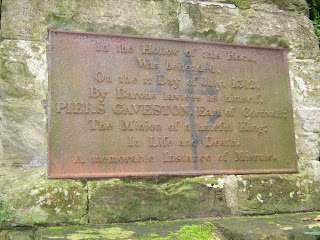
The inscription on the Gaveston Cross.  Not very pleasant at all, but it does acknowledge the despicable role played by Warwick and Lancaster.


Saturday, 1 June 2019

Anne Boleyn blooms......

Today is the anniversary of the Coronation of Queen Anne Boleyn, June 1st 1533.   It was a moment of triumph for Anne, being given an elaborate coronation after waiting to become Henry VIII's wife and Queen of England.   Anne was also heavily pregnant- her daughter Elizabeth would be born early September.  Now, I'm in no way a gardening expert, but I did purchase an Anne Boleyb Rose tree a few years ago.   It usually starts to bud around May 19th, but is never in full flower.  Late this week, the buds broke into their usual beauty pink blooms, and it struck me only then, maybe the roses were meant to flower on Anne's coronation day, not the anniversary of her execution.  That would make much more sense!  Here's 'Anne Boleyn ' in full bloom.


I wonder if there's a Piers Gaveston rose?  Somehow I doubt it - but you never know.