Thursday, 22 September 2011

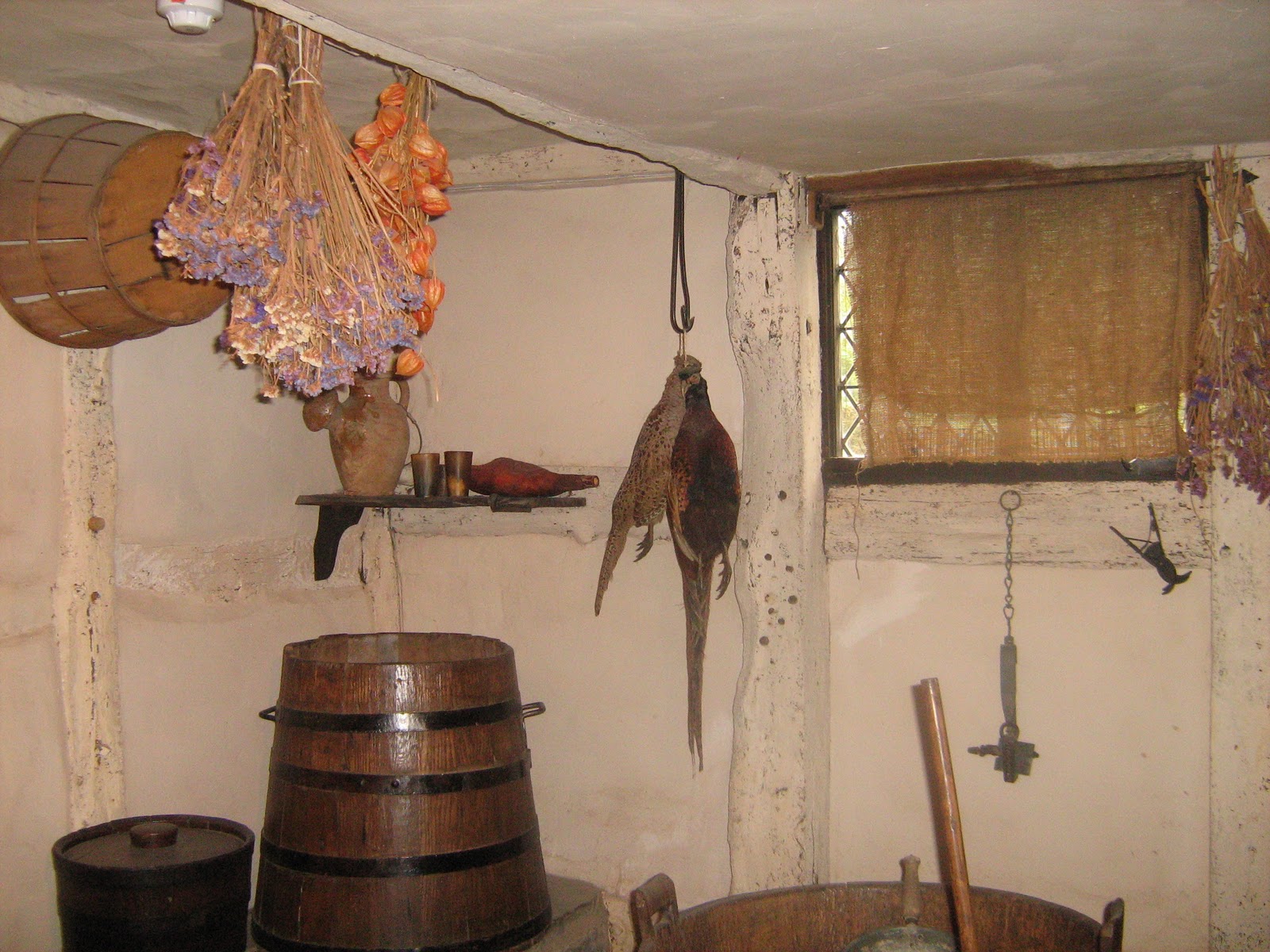
Inside Anne Hathaway's cottage

The 'bread oven' in the cottage.
 I'm afraid it's a bit of a lazy blog post today - more pictures from Anne Hathaway's cottage - this time from inside.  Of course, none of the artefacts inside actually belonged to William Shakespeare or Anne Hathaway.  In fact, the cottage was only two rooms when Anne lived there.  After her wedding to Shakespeare, she went to live with the Shakespeare family 'in town'.  However, as an insight to what life would have been like at that time - the 1560s - it's a wonderful educational tool.

A wooden trenchard - a 16th century dinner plate, with a groove for salt.
The guides inside the museum are extremely helpful and seem to enjoy discussing the contents of the cottage.  They were very knowledgeable.


Not the famous 'second best bed' left to Anne in her husband's will.


The kitchen is perhaps the highlight of the cottage.

Thursday, 1 September 2011

Those Insulting Nicknames……….

One of the charges levied against Piers Gaveston by his enemies was his arrogance and disregard for the nobility.  Recalled from exile by Edward II almost as soon as he became king, Piers wasted no time in upsetting the nobility.  He did this first at the tournament at Wallingford in December 1307, when the Earls of Warenne, Hereford and Arundel were all defeated.  Undoubtedly there were some who were jealous of his title of Earl of Cornwall, his royal bride Margaret de Clare and his intimacy with Edward II.  It seemed that Edward could deny his Piers nothing, even the ‘leading role’ at his coronation (Piers dressed in royal purple and carried the crown).  Piers had been chosen by King Edward Ist as a good role model for his son, with his gracefulness and good manners especially noted, and it seems Piers brimmed with confidence.  This confidence manifested itself in amusing himself and Edward by giving some of the nobles nicknames, which became public and were recorded.   The chronicler of the ‘Vita’ says ‘He showed his contempt for the earls and barons by giving them vile nicknames’. 

Henry de Lacy, Earl of Lincoln was called ‘burst belly’, Thomas of Lancaster was called ‘the churl’ or ‘the fiddler’, Amyer de Valence, the Earl of Pembroke,  was called Joseph the Jew and Guy Beauchamp, the Earl of Warwick, was known as the ‘black dog of Arden’.  Whether Piers called his brother-in-law, and the king’s nephew, Gilbert de Clare ‘whoreson’ is open to debate.  It would have been incredibly insulting to call Gilbert this, unless there had been some sort of falling out between Piers and his brother-in-law.  Gilbert did not come to Piers aid when he was captured after he returned to England after his third exile – he did nothing to help even though he knew Piers was in terrible danger.   Did Gilbert realise Piers’ cause was hopeless and threw in his lot with Warwick and the other nobles, even though he knew Edward would do anything to save Piers, and Amyer de Valence was hell-bent on protecting his honour?  Did the stinging nickname of ‘whoreson’ help him make up his mind?  Maybe there was some sort of dispute between Piers and Gilbert, with Piers choosing to insult Gilbert further by calling him ‘whoreson’.  

The other nicknames chosen by Piers for the earls might seem tame by the standards of today – ‘burst belly’ and ‘the fiddler’ seem fairly harmless.  But in the context of the times, they were highly insulting – these men were the most high-ranking men in the realm, relatives of the king and men who demanded respect.  They must have felt humiliated to have been so ‘teased’ by Piers – and Edward did nothing to reprimand Piers for using these names.  You get the feeling that Edward must have laughed in their faces.   Politicians are often given nicknames in jest today – John Prescott, former deputy prime minister was called ‘Two jags’ (after his use of ministerial cars)  and later ‘two jabs’ after an altercation with a member of the public.  Tony Blair has been referred to as Bambi and Miranda.  They take it in good humour as there is nothing they can do.  But the nobles at Edward’s court were infuriated.  The nicknames chosen by Piers may have had something to do with the appearance of the nobles.   You can just imagine Lincoln as being somewhat overweight and his clothes seemingly to be bursting at the seams.   Lancaster seems to have been given the ‘honour’ of two nicknames.  The definition of churl is an ill-bred person lacking refinement or someone who is selfish and unwilling to share.  This must have been chosen by Piers  as an indication of the character of Lancaster.   Did Lancaster resemble a fiddle player?  Or was Piers hinting at his manipulative nature?  ‘Joseph the Jew’ for Pembroke may well have something to do with Pembroke’s appearance.  
The noble who took the most offence seems to have been Guy de Beauchamp, Earl of Warwick.  Piers called him the ‘black dog/hound of Arden’.  Was this a reference to his physical appearance?  Was Piers mocking his temper, in that Warwick may literally have foamed at the mouth in temper?   Warwick is alleged to have warned Piers to beware the bite of the ‘black hound’.   I have wondered whether there might be more to these nicknames than we realise – was it a sly way for Piers to slander the nobles – were there some hidden meanings in these nicknames that have been lost to us?  Or was it that Piers resented the way the nobles ‘looked down’ on him?  That they despised his elevation to the earldom of Cornwall, and it was Piers way of ‘taking them down a peg or two’?  Or maybe it was a way of Edward and Piers just simply having some fun at the expense of the nobles?   Whatever the cause, the nobles were out-raged and chroniclers like the author of the Vita Secundi thought the insults so serious they recorded them.
For further reading on the subject of Piers' use of nicknames, see Kathryn's excellent post from her Edward II blog -

Wednesday, 10 August 2011

Anne Hathaway's cottage

OK, it's time for some 'pretty chocolate box' pix from my recent visit to the Cotswolds. This time it's Anne Hathaway's cottage - which I admit I completely fell in love with. In Anne's time, it consisted of 2 rooms, which have been added to considerably over the years. The female descendants of Anne continued to live in the house until the early 1900s when it was sold to the Shakespeare Birthplace trust.


Thursday, 4 August 2011

Blog round-up

Having some holiday time has allowed me to enjoy looking around at new history sites for me. Here are some of the new ones that have caught my eye.

Was thrilled to find this blog dedicated to Thomas Cromwell -

http://masterthomascromwell.wordpress.com/

I'm a huge admirer of Thomas Cromwell's career and he is often portrayed in dramas as a sinister character - think Donald Pleasance in 'The Six Wives of Henry VIII' or his portrayal in 'Anne of 1,000 days'.

Likewise, my favourite Tudor king, Henry VII, is often over-looked in favour of his son, Henry VIII, so I was pleased to find this blog -

http://henrytudorsociety.wordpress.com/

And a blog I've been reading for some time but haven't updated in my blog list -

http://www.theanneboleynfiles.com/

I also want to congratulate Kathryn at

http://edwardthesecond.blogspot.com/

on getting her article published in English Historical Review. It's been a long time coming!

And now that the Duchesses have released Susan from their custody, I'm enjoying her revamped blog

http://www.susanhigginbotham.com/blog/

Wednesday, 3 August 2011

The 'Kingmaker' exhibition at Warwick Castle

For some reason, I am always drawn back to Stratford-upon-Avon. I love to visit this part of the country. I last went there about 3 years ago, and decided a weeks visit was needed again this year. A visit to Stratford inevitably means a visit to Warwick castle - my favourite fortress after the Tower of London. Last time it poured with rain and my focus was the inside of the castle. This time, there was brilliant sunshine so my focus was outside. One day at Warwick Castle is never enough - and in fact the castle offers re-entry the following day for a £1. Of course, the castle has to keep pace and is heavily commercialised. New features are the 'Princess tower' - which I skipped - and the Dragon tower as featured in BBC tvs 'Merlin'. I enjoy this programme, but didn't have time to visit, plus there was an additional £7 fee to go inside. It costs £21 to enter the castle, although it is cheaper to book on-line, and keep a look out for 'buy one entry ticket , get one free' offers. I know these magnificent castles have to raise money and have to have appeal to broader audiences, and initially I found it very difficult to see what had been done to some of these castles, at the expense of the rich history of places. It quite pains me that there is no mention of Piers Gaveston at the castle. I always look around the dungeons, and there is an area called 'Prisoners walk'. I often wonder where Warwick kept Piers - in the dungeons/rooms above ground (for the more important/rich prisoners) or in the hellhole below. I have the feeling the 'Black dog' would have settled on the below ground ones.

One area where the castle excels is it's educational 'Kingmaker' exhibition. It hasn't changed from 3 years ago, and I can't ever see them getting rid of this exhibition - it is such a valuable educational tool. The exhibition is set on the eve of Richard Nevilles final battle in the 'Wars of the Roses', with Neville now fighting for the 'red rose' and King Henry VI. It shows the preparation for the battle and features a series of wax models, with sound effects. Here are some of the pictures I took.


The last picture shows Neville rallying his men.

Friday, 22 July 2011

England's Queens by Elizabeth Norton


I got this book after my visit to the National Portrait Gallery. It's called England's Queens and subtitled 'the private lives of....'. It's basically a biography of all the Queens of England, which is a real task for any writer - especially over about 450 pages. I've read a couple of Norton's books before, most notably on the wives of Henry VIII, particularly Anne Boleyn. They are very readable, but contain no real new information, and are a straight forward narrative of their lives. This seems to follow the previous books. So far, I've only read the very short chapter on Isabella, consort of Edward II - for obvious reasons! Nothing new in her mentions of Piers Gaveston - all the well-known incidents are there. Norton mentions Isabella marrying Edward II and seemingly not knowing anything about Gaveston. This always intrigues me because surely the French court must have known Edward 1st had banished Gaveston because of the closeness between his son and Piers. The story of Piers receiving the wedding jewels and wearing them at the wedding feast is retold, with the out-raged uncles being furious. Norton believes that Edward and Piers were lovers, but she mentions Edward having an illegitimate son, and takes the view that Isabella accepted the relationship between Edward and Piers as Piers was no threat to her, and the fact that she was pregnant while Piers was still alive is evidence that she lived a 'normal' married life with Edward and Piers' influence didn't stop her husband from having sex with her. That's refreshing! She exonerates Isabella from any plots against Piers, and doesn't make any suggestion that Edward and Piers abandoned Isabella in their flight - merely that they split up to ensure Piers' survival.


Much is made of the animosity between Isabella and Hugh Despencer. Norton believes Edward II was murdered, and that Isabella had a hand in it. She also repeats the tale of Isabella being married in her wedding dress, to show remorse for murdering her husband, and says that Isabella was buried in the same Greyfriars church as Mortimer - I can hear Kathryn's snort from here:)

I shall read the rest of the book, but I think it will be a case of dipping in and out of it.

Sunday, 17 July 2011

A Visit to the National Portrait Gallery

Finding myself in London over the weekend, I with a spare hour, I decided to visit the National Portrait Gallery. That makes 2 visits in the last 11 months. In my last visit, there was an exhibition on the portrayal of Lady Jane Grey - particularly the romanticised images from the Victorian era. Whenever I visit, I always find myself in the Tudor gallery. I have plenty of books with glossy pictures of the Tudors in, but there's nothing like coming 'face-to-face', as it were, with the real thing. You notice much more with the actual portrait than you would with any colour print in a book. Take this famous portrait of Anne Boleyn.


The detail on the dress on the actual portrait is amazing, particularly the detail on the fur on the sleeves of her dress, plus the decoration on the neckline. This portrait is described as being in a 'vulnerable' condition, and the gallery is asking for £4,000 in donations to repair it. The wood on which it has been painted is cracking. Visiting the gallery is free and they depend on donations.


Another of my favourite portraits is that of Thomas Cromwell, Earl of Essex. Again, seeing the portrait in the gallery is different to seeing it in a book. What strikes me about this portrait is Cromwell's 'double chin' and the lines around his eyes. He looks very severe, and in my opinion is not a 'vanity' portrait.


The gallery has developed the use of 'infra red' technology to 'see' beneath the original layers of the portrait. In this portrait of Thomas Cranmer, the artist changed the position of the hands, the lettering of the books Cranmer is reading, and a ring on the end of a piece of ribbon in one of the books has been painted out. Makes me wonder did Cranmer himself ask for the changes or was it the artist?


This portrait of the young Edward VI is clearly meant to show him in one of his father's typical poses. Infra red technology shows, however, that the pose was more exaggerated than the final portrait. Edward's right foot has been re-painted - he originally had his legs further apart, but maybe the artist realised the pose looked ridiculous on a child. Edward is thought to be around 9 or 10 in the portrait. The arms of England appear in the right corner - these were added after the original portrait has been completed. It begs the question - was this portrait started before the death of Henry VIII? and the arms painted in when Edward became king?


I grew up with this portrait identified as Lady Jane Grey. It was only a few years ago it was identified as Catherine Parr, Henry VIII's sixth wife. It's all to do with the crown-shaped brooch the sitter is wearing - it's been identified in an inventory of Catherine's jewels. It's a full-length portrait, and I love the detail of her hands.


Of course, the one portrait I would love to see, that of Piers Gaveston, doesn't exist. Edward II wold surely have had a portrait of him painted. Of course, the earlier portraits of monarchs and nobility are much cruder that the Tudor portraits. Edward IV's hands look far too small for him in his portrait. But however 'crude', it would be a dream come true, to use a popular cliche, if such a portrait were discovered.


The gallery allows you to investigate the portraits in a special room on pcs. You can buy prints of the portraits, and it has a great gift shop, selling things such as faux pearl Anne Bolyen necklaces! And of course, the gallery itself is free.