Monday, 21 September 2015

Piers Gaveston and...........David Cameron?????

Piers Gaveston is in the news today, along with Britain's Prime Minister 'Call me Dave' Cameron.   I shall let the papers do the talking for me.  From The Guardian newspaper today -

What have we learned about David Cameron today?

An unofficial biography of David Cameron written by the Conservative donor Lord Ashcroft contains a series of allegations. They include that the prime minister spent time in a drug-taking environment at university, that he took part in a bizarre dinner club initiation ritual, and another claim about Cameron’s knowledge of the peer’s offshore tax status.
One specific allegation is that, in the words of the Daily Mail, Cameron took part in an initiation ceremony in which he “put a private part of his anatomy” into a dead pig’s mouth. It cites a source – a current MP – who claims to have seen photographic evidence. It allegedly took place at a notorious Oxford University drinking club, the Piers Gaveston Society.

What is the Piers Gaveston Society?

“Piers Gav” is highly exclusive, made up of a self-selecting group of 12 undergraduates. The men-only club, named after the alleged male lover of Edward II, king of England from 1307 to 1327, was founded in 1977 and carries the motto: “Fane non memini ne audisse unum alterum ita dilixisse.” It translates to:

Truly, none remember hearing of a man enjoying another so much.
The Mail reports that the club encourages “excess, high camp [and] ostentatious decadence”.
Piers Gaveston members are understood to be given obscure titles such as “Poker”, “Despenser” and “Catamite”, and they all follow the Sicilian code ofOmertà – or maintaining silence about the club. In fact, it prides itself on being a clandestine organisation.

What do people say about it?

Valentine Guinness, one of the founders of the society, once told the journalist Toby Young that the appearance of Piers Gav and other similar societies in the 70s “was a conscious effort to say, look, you know, the country may be in a mess but we’re still going to have a good time”.
And so they do. For its summer ball, members each invite 20 guests – preferably more women than men, who were last year given 72 hours’ notice, when they were told to turn up for a hired coach that would drive them to an undisclosed destination in the countryside. “Cross-dressing is as likely to feature as speed-laced jelly,” says the Telegraph of these parties. “The rules are simple – there are none.”
The journalist Danny Kemp went to the Piers Gaveston ball in summer 1995. He has a different take on the club. “I guess the first thing to say is that it really wasn’t very debauched,” he said. “I was invited by a friend of a friend who was in the Piers Gaveston Society. The most obvious thing is that it is meant to be raunchy fancy dress. This means a lot of people going in drag [myself included unfortunately], others in what back then looked like bondage-type gear.
“Invitees were told to gather in a central Oxford location, where a coach picked everyone up and drove them to a location in a field on the outskirts of the city. There was a big marquee in the field, with what was again meant to look like louche decor, velvet, etc, and bowls of free punch to drink. I think they had some kind of burlesque-type dancing on a stage, but it was mainly just 90s house, techno and people dancing, in drag.
“I was expecting it to be a bit more interesting than it was. And, really, that was it. No pigs’ heads. The whole thing really seemed like not-terribly-debauched public schoolboys’ idea of debauchery.”
The broadcaster Julia Hartley-Brewer went to Piers Gaveston parties in 1989-91. She said they were “just big, fairly wild parties. Lots of drink, lots of very rich posh kids getting wasted – probably lots of drugs [but not my thing so I wouldn’t know]. They were fun bashes – very hot and sweaty and very much about getting off with people.”
Jules Evans, author of Philosophy for Life: And Other Dangerous Situations and policy director at Queen Mary’s Centre for History of Emotions, was a member of Piers Gaveston in 1997. He said it was not a secret society, rather just a club that organised a summer party. “They were pretty innocuous – basically a fancy dress rave. Not nearly as decadent as the media or the participants themselves liked to think. Didn’t stop the Sun sending a reporter and photographer and calling it an ‘orgy’,” he said.

What’s the difference between Piers Gaveston and the Bullingdon Club?

The Bullingdon Club is the other drinking society Cameron was known to be a member of. Most of the sonorous members of the Bullingdon are old Etonians. The prime minister was one such member, as were the London mayor, Boris Johnson and the chancellor, George Osborne.
The Guardian even publishes this picture.

Poor Piers - somehow being linked to ex-public schoolboys, pigs heads, strange and perverse initiation ceremonies and David Cameron - is not quite what he'd like to be associated with, I'm sure.

Thursday, 3 September 2015

Summer Holidays.......

I guess September marks the end of the summer in the U.K.  As well as my visit to Rome, I also did some 'castle visiting' - all ones I've been to in the past, but if you get the chance to go, well, you just have to, right?  So here's some of the 'best of pix'.  Hope you enjoy!

An old favourite - Sudeley Castle.  

The Victorian tomb for Katherine Parr.
Not surprisingly, Sudeley has a huge focus on Richard III at the moment.  As Duke of Gloucester, Richard held the castle during his brother Edward IV's reign.   There is a replica of the head made of Richard III, as well as information about his life when Duke of Gloucester.  You can even buy a white rose flag in the gift shop!  Of course, as a Lancastrian supporter, I quickly passed by!

Next on my visits was Windsor Castle.  I hadn't been there for nearly 20 years!  It's not one of my favourite castles, but I always visit the chapel of St. George.  I'm always amused that Henry VIII has no fine tomb, and lies under a slab in a vault.


St. George's Chapel


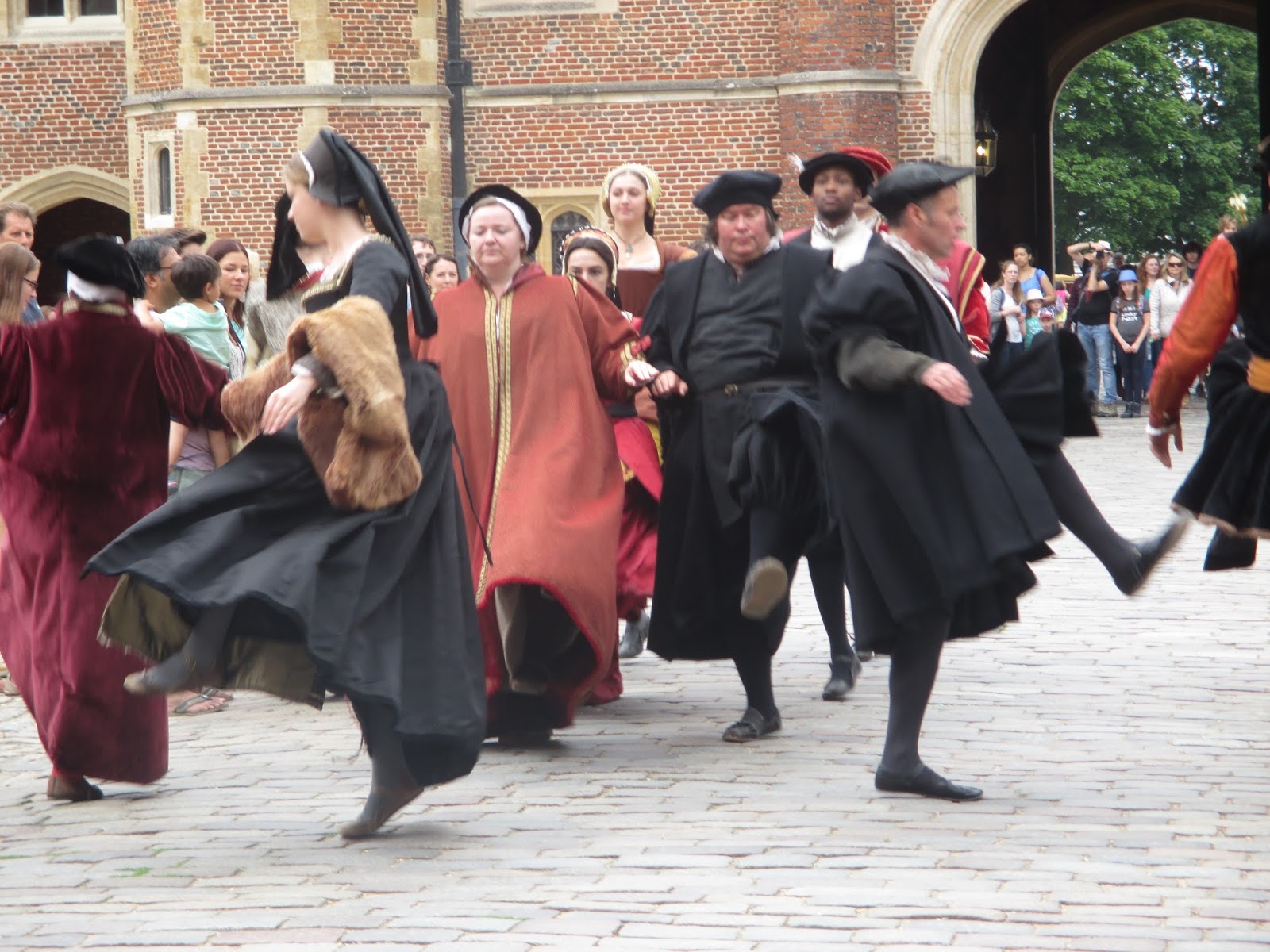
Hampton Court is celebrating 500 years this year.  I've visited the palace quite a few times, and naturally prefer to Tudor part of the palace.   There are lots of celebrations and events taking place, so if you can get there,  Unfortunately, the 'mini-timeplays' have ended.  Highlights included the arrival of Henry VIII's court, entertaining us with singing and dancing.  Anne Boleyn was amongst the performers.  Elizabeth 1st interrogated a Scottish envoy about her cousin Mary, Queen, of Scots, Shakespeare and his company rehearsed  a play for King James, Barbara Villiers, mistress of Charles II, argued with his wife, Catherine of Braganza and George 1st had an English lesson.


Henry VIII's court arrives at Hampton Court.

Anne Boleyn, as a lady-in-waiting, is escorted into the palace.


Tuesday, 11 August 2015

The Roman Forum

OK, I' m getting the last of my holiday posts out of the way!  On my first visit to Rome, I didn't get the chance to explore the Roman Forum, but this time I managed to spend quite a few hours amongst the ruins.  There was just too much to see, and once again it was absolutely sweltering!  Here are some of my photos.


Sunday, 9 August 2015

Holidays - Pompeii

I'm so sorry I have neglected this blog lately - and today's post is nothing to do with Piers, I'm afraid.  But it is the holiday season, and I've visited Italy, and in particular, I visited Pompeii, somewhere I've always wanted to visit.  So, I'm afraid, it's my holiday photos - hope you enjoy them!


The remains of houses on a street in Pompeii.

A garden has been added to one of the richer houses in Pompeii to try to reconstruct what it might have been like.


Ah yes, one of the rooms from the brothel at Pompeii.

The detail from a fresco at one of the richer houses in Pompeii.

From the gymnasium at Pompeii.

One of the shops at Pompeii - the holes would have held pots containing food.
Pots etc recovered from excavations in Pompeii.

The forum at Pompeii.

Friday, 3 July 2015

Anne Boleyn in residence at the Tower of London

The Tower of London is a place I never get tired of.  I visit as often as I can.  I live quite a way from it, but if I lived in London I'd go at least once a month!  One of the things I like about the Tower - and the other royal palaces - are their little 'snap-shots' in time.  I've been lucky enough to 'meet' Edward II, the infamous Judge Jeffreys, Henry VIII, Katherine Parr (as Lady Latimar and Queen) and er, Jane Seymour.  Finally, I got to 'meet' Anne Boleyn!  Anne and her brother George are in residence in the Tower this summer.  The scenario is Anne is at the Tower preparing for her Coronation.  She is accompanied by Thomas Cromwell, Lady Kingston, Francis Weston and her brother George Boleyn.  George and Francis challenge each other for her favour.  The whole show lasts half and hour, and takes place about 3 times a day near the White Tower.  I really enjoyed the performance and had interesting chats with the characters and the people who portray them.  Here are some of my photos.


 Francis Westen awaits the arrival of the new Queen.
(the ravens are sometimes kept in the cage behind)

 George Boleyn greets his sister Anne, whose
arrived at the Tower for her Coronation.
(note the digger behind
helping to build a new
staircase for the White
Tower).


Lady Kingston chats to Thomas Cromwell  who has come to
oversee preparations for the Coronation. 
Anne and Lady Kingston take their
places to watch George and Francis battle for her favours.


The 'duel' begins.
Both performers 
used a range of weapons. 


Anne is delighted with the show and 'knights' both Francis and George.

The crowd really got involved and it was good fun.  Of course, I couldn't help thinking that Anne, George, Francis and Thomas Cromwell had all been imprisoned in the Tower, executed nearby (Anne on Tower green), and all were buried in the chapel of St. Peter ad Vincula, the other side of the White Tower.
The memorial to those executed within the Tower grounds.

Friday, 19 June 2015

Ah, June 19th.....

Today marks the anniversary of the death, or should we say, murder of Piers Gaveston at Blacklow Hill, near Warwick.  Local legends claim that the sounds of bells, trumpets and jeering can still be heard.   I hope not - Piers deserves to rest in peace.

I found this post from Kathryn's old Edward II forum from the Leek Wootton History Society -


Hi everyone,
I have only just heard about this forum from someone who has researched Edward II, would like to visit the site and was directed to our website as well this one.
I've been reading the postings and would like to reply to a couple of things.
Piers Gaveston is the only person who is recorded as having been executed on Blacklow Hill - this is because (as Anejre says) the Earl of Warwick did not want him to be executed on his own land and Blacklow Hill was the nearest suitable location - it was never a regular site of execution. As for the legend that on some mornings you can hear the bells on Gavestons horse passing down the road from Warwick, a friend of mine rented a nearby farm cottage at one time and told me she heard them once - before she'd heard the legend.
Bertie Greatheed of Guy's Cliffe (a nearby ruined manor which can bee seen from the R Avon behind the Saxon Mill pub) had the monument built in 1821. It is understood that he was a regency 'romantic' character. He had a telescope through which he could read the inscription on the cross from the house. During the Victorian period there are many postcards of the cross standing proudly on top of a hill with no trees around - it must have been magnificent! The cross is on top of a rock that has an older carving on it stating it to be the spot where Gaveston was beheaded.
With reference to the 1312 date on the plaque and 1311 carved in the rock, we've always put this down to the change in calendars causing inconsistent dates. The older carving in the rock says 1311.
As Chazza said, it is overgrown and vandalised and has been a secluded spot where kids have gathered for many years - tucked away as it is. I know that the Parish Council would have liked to have done something about its condition, especially for this year, its anniversary. The woodland is owned by the descendants of Bertie Greatheed, but the farmer who owns the surrounding fields does not want a public footpath across his land. Personally I think that if the trees between it and the A46 were taken down and perhaps the cross were spotlit, it would discourage groups of kids from hanging around up there at night. We believe it is really only since the bypass was built in the early 70s that it has been so overlooked, before that, there was an established footpath past it, but the road cut that off. There is reference in a wartime diary to the writer taking a walk up there.
But if you can visit during the snowdrop or bluebell seasons, then Blacklow Hill is a really beautiful sight - I was up there once when it was carpeted with bluebells and saw a fox meandering through them.
If anyone needs guidance to find the monument, contact Leek Wootton History Group (www.leekwoottonandguyscliffe.org.uk/history_group.htm).
Helen


Wednesday, 17 June 2015

Trial of Piers Gaveston - what trial?

Having been captured by Guy of Warwick, it seems Piers' fate was sealed.  He was taken to Warwick Castle and kept prisoner there.  And yet it took 10 days from Piers' capture until his 'execution'.  Why?   It is not known if Warwick was acting alone - but once he had Piers in his custody, it wasn't long before some of the other nobles rallied to Warwick.  Thomas of Lancaster undoubtedly travelled to Warwick with relish - he may well have known Warwick's intentions, although Lancaster would surely have loved to have taken Piers prisoner himself.  The Earls of Hereford and Arundel followed.  Lancaster seems to have taken control of the situation.

Meanwhile, Aymer de Valence, Earl of Pembroke, was in a state of panic.  He'd sworn an oath to protect Piers, with his lands forfeit if he failed to do so.  His first action was to appeal to Edward II's cousin Gilbert de Clare, Earl of Gloucester, and Piers' brother-in-law.  I am still shocked at Gloucester's callous reply.  'My lord earl,  the wrong done to you is not to be imputed to Earl Guy.  He did this with our aid and counsel; and if, as you say, you have pledged your lands, you have lost them anyhow.  It only remains to advise you to learn another time to negotiate more cautiously'.  Pembroke was as concerned about his lands as he was Piers.  Why Gloucester abandoned Piers is not known - but perhaps he was jealous of the honours and access to the king Piers had. 

According to the chronicle of Trokelowe, Lancaster warned 'while he lives there will be no safe peace in the realm of England, as many proofs have hitherto shown us'.  Lancaster and Warwick dominated proceedings.  Piers' 'trial' was a farce - he was not even allowed to speak in his defence, and no doubt the verdict was already reached.  The canon of Bridlington claims two royal justices, William Inge and Henry Spigurnel, were called in to examine the evidence and pronounced Piers guilty.  Yet Kathryn Warner points out that Edward II took no action against them.   No doubt they were pressured into a 'verdict'. The nobles seem to be more concerned that they would suffer no repercussions, with Lancaster and Warwick promising Hereford they would support him against any losses he incurred.  No doubt many deals were committed to parchment and seals attached.   What a shame they don't survive.  Everything was agreed - Piers was to die on June 19th.

Piers was taken out of Warwick by Lancaster and some of his followers.  Guy of Warwick stayed in his castle.  I have to wonder why he did not accompany Piers on his journey to Blacklow Hill.  Surely witnessing the destruction of his hated enemy would be a chance not to be missed?  Or did his conscience trouble him?  Not for the death of Piers - but the cowardly manner of it.  It was not an execution - it was murder.  Warwick seems to have insisted that Piers' 'execution' take place away from his lands - Blacklow Hill was on Lancaster's lands.  And yet, even Lancaster's resolve seems to have been shaken.  It was agreed that Piers would suffer a 'noble' death - beheading, out of respect of his kinship to Gloucester.  But Lancaster chose not to witness it himself and handed Piers over to 2 of his Welsh soldiers, who took Piers out of sight of Lancaster.  One soldier ran him through with his sword, and the other cut off his head.  Not exactly a 'noble' death.  Lancaster only required to see the head to make sure, and Piers body and head were abandoned.  Neither Warwick or Lancaster wanted to take responsibility for Piers' remains.  Where was their bravado and courage now?  No doubt Warwick trembled in his castle, whilst Lancaster  waited for the rage of Edward II.

Below - the wood surrounding Blacklow Hill.


The monument at Blacklow Hill where Piers Gaveston was killed.

Sources:

Piers Gaveston, Earl of Cornwall, 1307-12: Politics and Patronage in the Reign of Edward II, Hamilton

Edward II: The Unconventional King  Kathryn Warner