Sunday, 18 November 2012

Uncertain Proof - a film about the possible survival of Edward II


I first heard of this film on Kathryn’s ‘Edward II’ blog.  It was in production and that was all I heard about it.  So I was delighted to see it for sale in Berkeley Castle shop.  I bought it of course!  It tells the story of Manuel de Fieschi’s quest to find out what happened at Berkeley Castle in 1327.  In an interview with the screenwriter, A. G. Ford, on a second disc, the screenplay is first and foremost written as a piece of drama, about a conversation between the supposed Edward II and Manuel de Fieschi.   It was the discovery of a copy of Manuel de Fieschi’s letter that led to debate about the possible survival of Edward II, and how he lived out his life as a hermit in Italy.   So the film itself is not an exact account of what de Fieschi claimed. 

In this version, de Fieschi has attended the court of Edward II and seen him and his lover Hugh Despencer at court.  Later on, he claims to have been at Berkeley and heard the screams of Edward II.  These scenes are in flashback, and we have a young de Fieschi as a priest having heard the strange story of an English hermit who lives high on a remote mountain.  We don’t really know why de Fieschi is convinced the hermit is Edward – in fact, we just find out that he is desperate to be taken to see this hermit, and the isolation and bleakness of the hermit’s home dominates the first 20 minutes.   When he reaches the remains of an old farm inhabited by a woman who feeds the hermit, we learn about the life of self-imposed hardship of the hermit.  He lives in a disused pig-sty, which he locks from the inside, and he is therefore his own jailor.  He comes out at certain times to eat the bread and water left by the woman, with whom he has virtually no contact.  He has built his own altar and appears daily to worship there.  Fieschi is deliberately portrayed as an arrogant young man with little calling to the priesthood, and when the old man appears, he continually goads him for deserting his duty as king.  He cannot understand how someone who has lived as a king can now live like this.  The hermit goes about his business, washing, eating etc, whilst Fieschi rants about the life Edward led with Piers Gaveston (yes, he gets a mention!) and Hugh Despencer, reminding Edward of the awful death suffered by Despencer.  He talks about life at the court and kingly duty.  Eventually, the hermit, who has not admitted to being Edward II, decides to talk to the young priest and explains his reasoning.  He speculates what this Edward might say.  Basically, the old man longs for death, but will not take his life, and regrets nothing, except the death of the old porter – the first admission by the hermit that he is Edward II.  We are not able to witness their full conversation, but de Fieschi comes away much moved by the hermit’s story.  I have to admit, I found the film deeply moving as well – to think that Edward now lived this poor, remote life with nothing to look forward to but death.  There was no contact with anyone, and his life must have been dominated by the events of his reign.  It is of course only an interpretation, but one that shows great sympathy for the supposed Edward, and whilst I do not believe the ‘red hot poker story’ and strongly believe Edward survived, it made me question the misery of the survival he may have endured.  Well worth watching.


Sunday, 11 November 2012

More pix from Berkeley

It seems to be the norm now, that most castles don't allow photography in them anymore.  I feel guilty, but there are times I just have to have a photo.  Here are a couple of sneaky pix from Berkeley.

 Not a very good one of the so-called dungeon at Berkeley.  It seems to be a well, and it was here, according to one chronicler, where the carcasses of dead animal  were thrown in the hope the putrid smell would kill off Edward II - as well as most of the other occupants as it right in the middle of the castle!

 The material which has been nailed to the wall in one part of the castle is allegedly a tapestry from one of the tents of Henry VIII at the Field of Cloth of Gold, and was put in place for a visit for Henry VIII and Anne Boleyn.
 Their daughter, Elizabeth Ist, also visited the castle, and this is the bed covering used for her visit.
There's very little of it left, but this flag was the English standard from the battle of Flodden in 1513.
And of course, wherever Edward II has been, there just has to be some mention of Piers!  He gets everywhere:)

Friday, 2 November 2012

A Visit to Berkeley Castle - and no sign of a poker!

This week I made it to Berkeley Castle before it closes for the winter.  I have been to Berkeley before  - about 20 years ago.  The castle has very restricted visiting times, and is closed every Friday and Saturday - even at the height of summer.  It makes a very lucrative living from hosting weddings, and can obviously benefit from closing on those days.  It is a fine castle, and has been in the hands of the Berkeley family for almost 800 years.  The family are proud to say on their website that the castle has not been 'romanticised' or modernised by the Victorians, and the castle is  'a Norman fortress with an enclosing curtain wall, built and enlarged through the medieval period and beyond into a secure, comfortable, substantial home.'

Of course, the main reason for my visit was to see the 'cell' that Edward II was kept in when he was deposed and kept prisoner there.  He was kept in some comfort and treated well.   You can't go into the cell, but have to look through some grating in a wall to see how it might have looked.


Of course, someone on the guided tour just had to ask where was the famous red hot poker, which was used to murder Edward II.  The guide was very sensible, and said it was most likely a myth, and that if Edward had been murdered in that cell, he would probably have been smothered or poisoned.  She even said there are stories that Edward escaped and survived, although sadly, she then added she found it ridiculous that his body was returned and buried in Gloucester Cathedral 20 years later.  She obviously needs to read the work of Ian Mortimer and check out Kathryn's website.


Despite the presence of a famous royal prisoner, apart from the cell, there's very little else to do with Edward II there.  Having sold out of guidebooks as it was the end of the season, we had to rely on the guide to get any background to Edward's story, and it was the usual information - Edward was a bad husband, gave his favourite his wedding presents etc, etc.  I could only shake my head.  At least the red hot poker story seems to be on it's way out.


Sunday, 21 October 2012

Raglan Castle

I have really neglected this blog this month, and have nothing Piers-related to post.  However, I came across some more pictures of Raglan Castle from my visit earlier this year.  There's very little of the castle left which Henry VII would have known as a child.  He was a sort of hostage there of Lord Herbert, and his Queen, Elizabeth of York, visited the castle on her own progress.


Monday, 1 October 2012

The mortuary chests at Winchester Cathedral

All this coverage of the possible discovery of the bones of Richard III reminded me of a conversation I had with a guide about the mortuary chests in Winchester Cathedral.  The chests contain the bones of the Anglo-Saxon kings, for example, Cnut, and possibly the bones of William Rufus.  During the time of the Civil war, soldiers destroyed the tombs of the old kings, as well as smashing the stained glass windows and ruining the medieval carvings.  The people of Winchester gathered up the bones, and placed them in mortuary chests, which are placed high up in the cathedral.  Some say the bones of William Rufus are mixed in with them, but there is also a plaque which supposedly marks the place where he is buried.  The chests are due to be opened - right now - and examinations/DNA work carried out on the bones.  I managed to take a few pictures, but I'm afraid the light was not great.


The picture of the carvings shows the Victorians attempts to recreate the original medieval carvings.  The stained glass windows were reconstructed by the townspeople shortly after they were smashed.  Interestingly, the remains of King Alfred were buried in Winchester's old minster, and later moved to Hyde Abbey, and lost in the Reformation.

Winchester also contains the shrine of St Swithun, whose remains were also dug up and discarded.  All this makes me wonder how on earth Piers Gaveston's father's tomb remained intact!


Winchester Cathedral also contains the grave of the novelist Jane Austen, who died whilst visiting Winchester. 

Sunday, 23 September 2012

More pictures of Sudeley castle

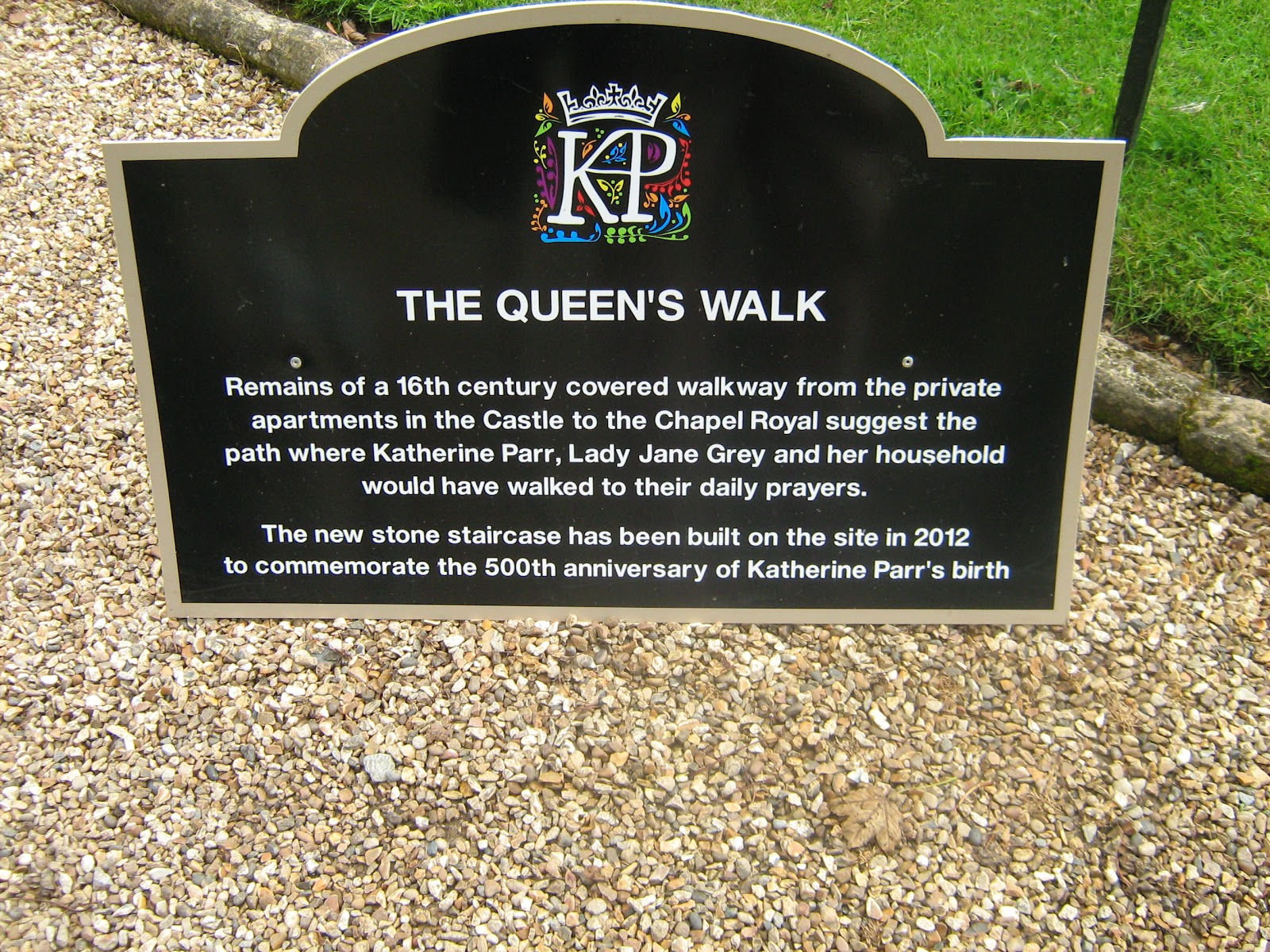
The de Sudeleys date back to the Norman conquest.   There has been some sort of castle there since the Conquest.  One of the descendants, a second son, took his mother's name of de Tracy, and was one of the knights who killed Thomas A Beckett.  At one time, the castle was in the possession of Richard III, as Duke of Gloucester.  He added to the existing structure.  The castle passed into the hands of the monarchy, and Henry VIII and Anne Boleyn stayed there.  The real damage to the castle was done in the time of the civil war, when it was blasted with cannon fire.  It has been restored by the Dent-Brocklehurst family.


 In case anyone is wondering, there is a modern sculpture attached to the castle walls.


Friday, 14 September 2012

Quincentenary of the birth of Katherine Parr at Sudeley castle

This summer I was fortunate to visit Sudeley Castle, near Cheltenham, in the quincentenary year of the birth of Katherine Parr, the sixth wife of Henry VIII.  The castle is always worth a visit, but this year, there is a fantastic exhibition running on Katherine Parr with several events taking/taken place to mark the occasion.  Those involved include David Starkey and Alison Weir.  You can see a special film created by David Starkey in which he talks about the personality and character of Katherine.  Katherine must have had an enormous influence on her step-daughter Elizabeth, and the young Jane Grey, who was the ward of Katherine's fourth husband, Thomas Seymour.  She showed them that a woman could wield power, having acted as Regent for her husband Henry VIII when he was at war with France.  She was also the first woman to have her books published in her own lifetime.  Also on show are the costumes used in Starkey's 'Six Wives' documentary for channel 4.  You can see several items that belonged to Katherine, such as a piece of one of her dresses and some of her books, and see the recently restored rooms in her apartments, which had previously been destroyed by fire. 

Sudeley castle is unique in that it is the only private castle in which a Queen of England has been buried.  The story of Katherine's tomb is well known - how, after the castle fell into ruin during Oliver Cromwell's time, and the church was used to stable the horses belonging to the Roundheads, her tomb was discovered by a group of ladies on a walking tour in 1782, who had heard the former queen was buried there.  A slab on top of the tomb had broken, and the coffin was exposed.  Katherine's body had been wrapped in lead, and  a small portion was removed to view her head and one of her arms.  Her body was perfectly intact, her flesh being described as still 'moist and white'.  A lock of her hair and one of her teeth were removed, as well as a piece of seer cloth.   The body was then re-covered.  However, word had got out about the discovery, and the coffin was continually re-opened, so that barely 6 months later, the body had began to seriously decay.  When the Dent family took control of the castle in the 19th century, Katherine was given a proper burial with a fine marble effigy on top of the tomb.  You can see the hair, tooth and portion of seer cloth on show at Sudeley. 

One of the exhibits on show is a piece of lace that was woven by Anne Boleyn for her daughter Elizabeth, which Elizabeth gave to Katherine Parr.  You can clearly see Anne's device of the falcon woven into it.


Above, the ruins of Sudeley castle, the church, and the tomb of Katherine Parr.


A fragmanet of a dress belonging to Katherine Parr
 
 A lock of Katherine's hair and one of her teeth.  (These were not supposed to be photographed!)
The cloth woven by Anne Boleyn and given to her daughter Elizabeth.